Key takeaways
- Verified capture within hours of FNOL reduces reserve uncertainty.
- Geofencing, time windows, and hashing block the common fraud patterns.
- Desk adjusters absorb cat surge without a field hiring cycle.
- The output drops straight into the claims platform.
Where it fits in the claim lifecycle
At first notice of loss, speed decides cost. A verified photo set collected within hours of FNOL narrows reserve uncertainty and prevents the damage from changing before anyone documents it.
Downstream, the same record supports subrogation, reinspection, and litigation without a second visit.
The fraud controls carriers care about
Geofencing rejects captures taken outside the risk address radius — the single most common vector for opportunistic claim padding.
Time windows block backdated submissions, and perceptual hashing detects photos recycled from a prior claim.
Screen-recapture and edit detection reject photographed monitors and retouched damage before the file enters the claim.
Catastrophe surge without hiring
Cat events break capacity models because the constraint is bodies on the ground. Virtual inspections let a desk adjuster handle a multiple of their normal caseload while reserving field visits for total losses and complex structures.
Because the flow is templated, quality does not degrade when volume spikes.
What the adjuster receives
A structured record: required photo set, damage close-ups, AI-flagged conditions, notes tied to individual photos, GPS and timestamp per frame, and a signed PDF for the claim file.
It pushes into the claims platform automatically over webhook or API, so nobody re-keys anything.
Prepare a photo request that answers the adjuster’s questions
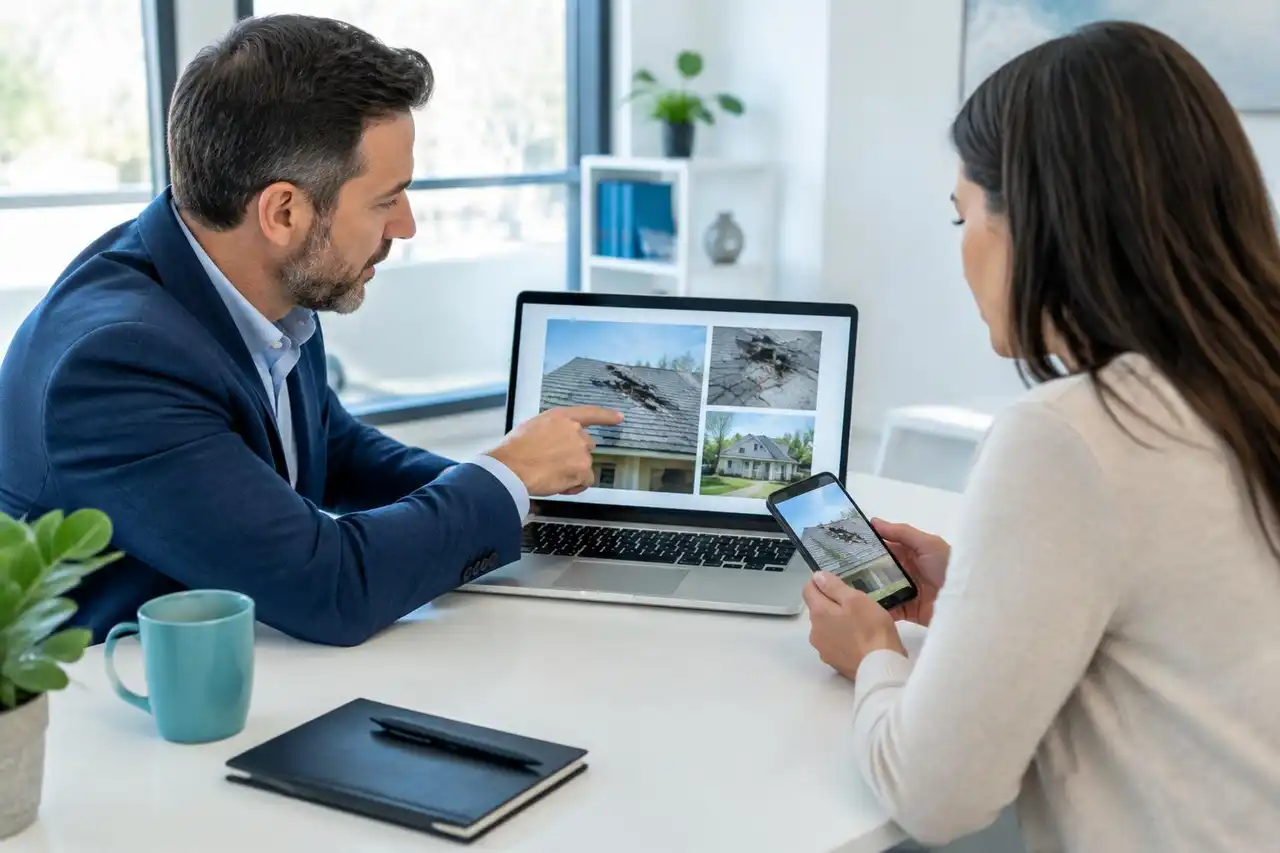
With Virtual Inspection Pro, the adjuster sends a geofenced, time-limited link at first notice of loss. The policyholder documents damage from their phone, every photo is fraud-checked, and the verified set reaches the claim file the same day. That delivery supports review; it does not establish coverage, determine the loss amount, or guarantee same-day payment.
Before sending the link, the claims team should confirm the loss location, contact details, reported damage, and whether the property is safe to enter. Explain the capture deadline and provide a short shot list: an exterior overview, each affected room, wider views showing where damage sits, and close-ups with a safe size reference. Request relevant labels or serial numbers only when accessible. Tell policyholders not to climb roofs, enter standing water, disturb damaged wiring, or delay necessary emergency assistance to take photographs.
Treat fraud checks as evidence screening, not a verdict
A virtual claims inspection should separate image screening from the coverage decision. Although every submitted photo is fraud-checked, a check is not proof that an image is authentic, complete, or sufficient to establish causation. The adjuster should compare the images with the reported loss, policy information, prior documentation, and any unresolved inconsistencies.
Geofencing also has limits. GPS.gov explains that positioning accuracy depends on factors including signal blockage, satellite geometry, and receiver quality. A location discrepancy therefore warrants investigation rather than an automatic insurance photo fraud allegation. Ask for clarification, additional views, or a different inspection method when evidence conflicts.
For the carrier’s handling process, retain original submissions, record who reviewed them, and document why additional evidence was requested. NIST’s forensic guidance supports preserving data integrity and documenting handling; it does not certify this product or establish that a particular photograph proves a claim.
Set clear escalation, accessibility, and communication rules
Before starting, explain what the policyholder needs to photograph, how long the link remains usable, and whom to contact if capture fails. If the link expires or location validation prevents completion, the claims team should review the circumstances and arrange another documentation route. Do not assume that every claimant has reliable connectivity, a suitable phone, or the ability to photograph damage independently.
Human review is appropriate when photographs conflict, fraud concerns remain unresolved, coverage questions arise, or the claimant disputes what the images show. An in-person visit is appropriate when safe access, measurements, testing, or concealed conditions are material to the assessment.
Keep requests specific and explain the next step after submission. The NAIC Unfair Claims Settlement Practices Act is a model framework addressing claims investigation and communication, not a substitute for applicable state requirements. Carrier procedures should reflect the relevant jurisdiction and policy.
Keep reading
People also ask
- Does this work for policyholders who are not tech-savvy?
- Yes. There is no app or account, and an adjuster can escalate to a live guided session at any point if the policyholder gets stuck.
- Can we require specific photos for a peril type?
- Yes — templates branch by peril, so a hail claim and a water claim ask for different required captures.
- Is the evidence usable in litigation?
- Each file carries an integrity hash and full chain of custody that a third party can independently verify.
- Does a verified photo set mean my claim is approved?
- No. The adjuster still evaluates coverage, causation, damage scope, and any missing evidence before making a claim decision.
- What if I cannot safely photograph the damage?
- Do not enter unsafe areas. Contact the claims team to arrange alternative documentation, specialist review, or an in-person inspection.
Sources and further reading
Reviewed against authoritative guidance on September 30, 2026.
Need a hand with something more specific?
help@virtualinspection.ai